Key Terms

  • acyl group
  • acylation
  • alkylation
  • antiaromatic
  • arene
  • aromatic
  • benzyl group
  • electrophilic aromatic substitution
  • Friedel–Crafts reaction
  • inductive effect
  • heterocycle
  • meta (m)
  • ortho (o)
  • para (p)
  • phenyl group
  • resonance effect
  • ring-current

Summary of Reactions 8

Electrophilic aromatic substitution

  • Bromination (Section 8.3)

Benzene reacts with bromine in the presence of iron tribromide to yield bromobenzene and hydrogen bromide.

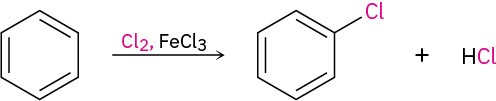
  • Chlorination (Section 8.4)

Benzene reacts with chlorine in the presence of iron trichloride to form chlorobenzene and hydrochloric acid.

  • Iodination (Section 8.4)

Benzene reacts with iodine in the presence of copper (2) chloride to form iodobenzene and hydrogen iodide.

  • Nitration (Section 8.4)

Benzene reacts with nitric acid in the presence of sulfuric acid to form nitrobenzene and water.

  • Sulfonation (Section 8.4)

Benzene reacts with sulfur trioxide in the presence of sulfuric acid to form benzene bonded to S O 3 H group.

  • Friedel–Crafts alkylation (Section 8.5)

Benzene reacts with methyl chloride in the presence of aluminum trichloride to form methyl benzene and hydrogen chloride.

  • Friedel–Crafts acylation (Section 8.5)
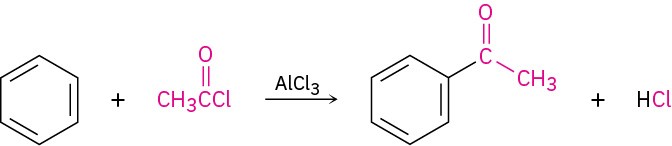
Benzene reacts with acetyl chloride in the presence of aluminum trichloride to form benzene bonded to an acetyl group and hydrogen chloride.

Oxidation and Reduction Reactions

  • Reduction of aromatic nitro groups (Section 8.4)
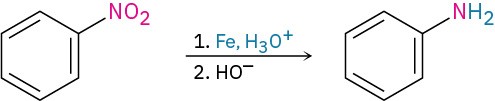
Nitrobenzene reacts with iron in the presence of acid in step 1, and base in step 2 to form a benzene ring bonded to an amino group.

  • Oxidation of alkylbenzene side chain (Section 8.8)
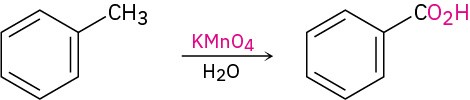
In water, toluene reacts with potassium permanganate to form benzoic acid.

  • Catalytic hydrogenation of aromatic ring (Section 8.8)
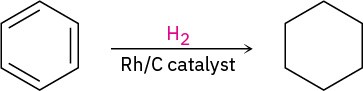
Benzene reacts with hydrogen to form cyclohexane.in the presence of rhodium on carbon as a catalyst

License

Icon for the Creative Commons Attribution-NonCommercial-ShareAlike 4.0 International License

Fundamentals of Organic Chemistry Copyright © by Kirsten Kramer and Cassandra Lilly is licensed under a Creative Commons Attribution-NonCommercial-ShareAlike 4.0 International License, except where otherwise noted.