2 Chapter 6 – Secondary Research
Learning Objectives
- Define secondary market research
- Summarize the PEST framework components and their implications for a business opportunity
- Justify the selection of secondary data for validating industry trends and market size.
- Construct a perceptual map to visualize the competitive landscape and identify market gaps.
- Analyze social media research and customer reviews to define competitor advantages and customer values.
Secondary Market Research
Secondary research is research that uses existing data that has been collected by another entity. Oftentimes, these data are collected by governmental agencies to answer a wide range of questions or issues that are common to many organizations and people. Secondary research often answers more general questions that an entrepreneur may have, such as population information, average purchases, or trends. If there is a specific question that cannot be answered, such as how many people would be interested in a new product with certain attributes, then primary research will have to answer that. While some of this kind of research must be purchased, much of it is free to the public and a good option for entrepreneurs with limited financial resources.
Some useful resources are trade organizations that provide information about specific industries, as well as newspapers, magazines, journals, chambers of commerce, and other organizations that collect local, state, national, and international data. Resources such as these can provide information about everything from population size to community demographics and spending habits. Table 6.1 below lists several free databases that are rich sources of information.
| Database | Information | URL Address |
|---|---|---|
| Census Bureau | Economic, demographic, geographic, and social data | https://www.census.gov/ |
| Fact Finder | Economic, population, and geographic data | https://factfinder.census.gov/ |
| American Community Survey | Updated census data | https://www.census.gov/programs-surveys/acs/ |
| Pew Research Center | Fact tank that surveys trends, issues, attitudes, and demographics | http://www.pewresearch.org |
| Pew Hispanic Center | Surveys on Hispanic trends, demographics, and issues | http://www.pewhispanic.org/ |
| Current Population Survey | Monthly survey of US households on labor data | http://www.bls.gov/cps/home.htm |
| Texas State Data Center | State demographic data | http://txsdc.utsa.edu/ |
| IBISWorld | US industry trends | http://www.ibisworld.com |
| Mergent Online | US businesses data | http://www.mergentonline.com/ |
| Demographics Now | US demographic and business data | http://www.demographicsnow.com/ |
Table 6.1
PEST analysis
One tool that can be used to analyze the external environment of a potential opportunity is called PEST analysis (political, economic, sociocultural, technological). In this analysis, we identify issues in each of these categories. The PEST framework is a strategic assessment tool that entrepreneurs can use to identify factors that may influence access to essential resources (See Figure 6.1).
Political Factors
Although you may hope to be your own boss, make your own schedule, and follow your own rules, you must still work within the realities of outside factors that affect your business. Political factors stem from changes in politics, such as the policies of a new presidential administration or congressional legislation. Such policies can affect access to capital, labor laws, and environmental regulations. Moreover, these political changes can take place on federal, state, and local levels. The figure below lists several political factors that can influence a business. Tax reform law, for example, could influence the amount of taxes a business owes, while actions by the newly appointed chair of the Federal Reserve could affect how much capital may cost the small business owner because of interest rate changes.
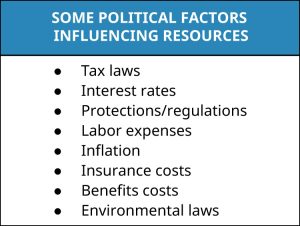
Businesses must also follow environmental laws, such as those from the Occupational Safety and Hazard Association and the Environmental Protection Agency (EPA). For example, these government agencies require businesses to train employees about materials that may be hazardous to people and provide notices and reports on these matters. The EPA also has regulations on air and water emissions that businesses must follow, as improper disposals can harm the environment. Smaller businesses may be exempt from some of the regulations under certain circumstances.
Imported products are regulated by the federal government through quotas and tariffs. Tariff laws have been used as political instruments to manage the flow of goods between countries. Tariffs are taxes or duties that are added to imported goods from another nation. Quotas, a limit on the number of items entering a country, are also used to restrict the volume of goods entering a country. For example, the US government in 2018 imposed tariffs on $550 billion of Chinese products, while China has imposed tariffs on $185 billion worth of US products. As of 2024, the White House has proposed a 100% tariff on all electric vehicles made in China. Free trade remains an ongoing source of international economic competition. As an entrepreneur, you should remain aware of political issues that may impact your operations and planning.
Economic Factors
Entrepreneurship has a direct impact on the economy by providing employment opportunities to many people. However, economic factors can also affect the success of a business. For example, they can deter customers from purchasing goods and services due to an economic downturn. On the other hand, when the economy is expanding and growing, people tend to feel confident about their jobs and income, and they may spend more than usual. Economic factors—which include inflation rates, interest, currency exchange (if the business operates or engages globally), state of the economy (growth or decline), employment rates, and disposable income—can impact the business owner’s pricing of goods or services, the demand for such services, and the cost of production.
Taking the state of the economy, for example, when the economy is down, restaurants will see a decline in clientele as more people prepare meals at home to save money, or they will switch from fine dining restaurants to more casual or fast-food restaurants. In weak economies, consumers tend to purchase store (often called “private label”) brands more often than national brands to reduce their grocery bill. When the economy is healthy, consumers spend more on entertainment and restaurants, which can be considered luxury items. The restaurant will need to adjust its resources to meet the economy-driven fluctuating demand. When demand is high, it is likely that the restaurant will need more supplies and more employees. These needs, in turn, result in the restaurant needing additional financial resources to buy more supplies and to pay employees. When demand is low, the opposite is true.
Sociocultural Factors
Knowing about your customers is key to delivering what they really want. Additional factors that need to be taken into consideration include changes in how society is moving and the direction of that movement as it relates to your customer base and potential new markets. These sociocultural factors include population growth rates, changes in where people live, social trends such as eating healthier and exercising, education levels, generational trends (baby boomer, Gen X, millennial, or Gen Z), and religious culture. It is necessary to look at these factors closely in order to assess if the opportunity you are pursuing has a market large enough to support it.
One far-reaching sociocultural factor is the impact that digital shopping has had on brick-and-mortar retailers. This online shopping trend has forced long-established companies such as JCPenney, Payless, Gap, Victoria’s Secret, Radio Shack, Macy’s, and Sears, to close thousands of stores, file for bankruptcy, or shut down the business altogether. These companies have faced enormous competition from entities such as Amazon and smaller businesses such as ModCloth and Birchbox that interact with customers virtually and stay on top of societal trends. Younger generations such as the millennial and Z generations have triggered these social changes, as they are technologically savvier and expect to find exactly what they want, where they want it, and when they want it.
Technological Factors
In the case of technological factors, the enterprise needs to be sure it has equipment that allows it to operate efficiently. There are different types of technology that help with marketing, finances, productivity, collaboration, design, and production. The drawback is that some of these technologies can be expensive to purchase, and it can take a long time to recuperate the cost. Entrepreneurs must be sure to acquire only those tools and materials that will help them get started. Then, as the business thrives, more funding is available for more expensive equipment and software
Industry analysis
As you explore ideas for your business venture, consider what industry your product or service operates in. An industry is a group of companies that are related based on their primary activities. For example, Delta, American Airlines, Spirit, Frontier, and United all belong to the airline industry. Conducting research on industry trends may provide valuable insight that will spark an idea for your product. An excellent source for industry information is the business reference section of your college library, here’s a link to NC State’s Business Research page.
Industry sources reveal knowledge about a specific industry from the perspective of identifying unmet needs or areas for improvement within that industry. For example, Airbnb reshaped the hotel industry by connecting travelers with property owners, so that the travelers could rent the property when the owner was not using it. As Airbnb has grown, the company has made improvements to their offerings in meeting the needs of the traveler’s demand based on property location and in categorizing the supply (the homeowner’s property) for increased efficiency, meeting the needs of both the property owner and the traveler. Researching specific industries from supply and demand perspectives, and noticing unused supplies, as we saw in the Airbnb example, also applies to other industries.
One industry that has excelled in change management post-pandemic is healthcare, particularly telemedicine. By leveraging advancements such as virtual consultations, phone screenings, and remote diagnostics, telemedicine has expanded access to urgent care for patients with limited medical services. According to the Centers for Disease Control and Prevention (CDC), telemedicine usage among office-based physicians increased by 71.1% (CDC, 2023). While the industry faces challenges, public opinion continues to shift in favor of online healthcare, with projections indicating that by 2026, 25–30% of all medical visits in the U.S. will be conducted remotely (McKinsey & Company, 2023).
Beyond healthcare, AI and cloud computing have also evolved significantly. With increased scalability and accelerated machine learning capabilities, these technologies continue to reshape industries. The global AI market is projected to reach a market cap of $1.8 trillion by 2030, while cloud computing is expected to grow to $2.5 trillion within the same timeframe (SCNSoft, 2023; McKinsey & Company, 2023). These advancements highlight how industries are not only adapting to change but actively driving innovation in a rapidly evolving digital landscape.
Another consumer trend is the demand for affordable housing. One solution involves offering more affordable “tiny homes” that make home ownership more accessible (see figure below). As one entrepreneurial opportunity materializes into a new product, spin-off ideas may also arise. The tiny home concept attracted the attention of groups that assist homeless veterans. The Veterans Community Project in Kansas City, has developed a community of forty-nine tiny homes for homeless veterans and the project is so successful that more than 500 cities around the country are building tiny home housing projects for veterans there.

competitive analysis
A competitive analysis should provide the entrepreneur with information about how competitors market their business and ways to penetrate the market by entry through product or service gaps in areas that your competitors do not serve or do not serve well. More importantly, competitive analysis helps the entrepreneur develop a competitive edge that will help create a sustainable revenue stream. For example, a big company like Walmart primarily competes on price. Small companies typically cannot compete on price, since the internal efficiencies and volume sales available to large corporations like Walmart are not available to small companies, but they may be able to compete successfully against Walmart on some other important variable such as better service, better-quality products, or unique buying experiences.
Perceptual mapping is a visual tool that can help entrepreneurs define which product attributes are most important to customers, the products that are currently offered, and find the gap where an opportunity may exist. For example, food box delivery services offer a convenient way for customers to purchase the ingredients and recipes needed to prepare meals at home without going to the grocery store. Let’s assume that two important attributes of food delivery boxes are organic and locally-sourced ingredients.
When creating a perceptual map, you want to plot out each company and where they fall along each axis. See the Figure 6.4 below which represents food delivery box competitors.
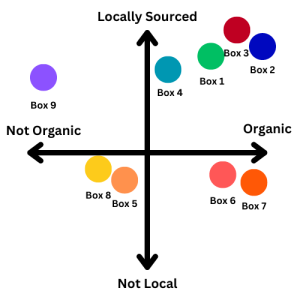
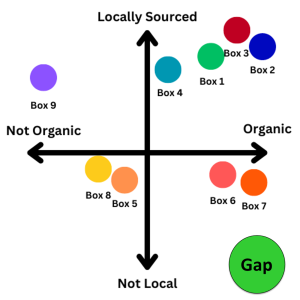
After examining the perceptual map, are there any gaps in the offerings? Within those gaps, can you find opportunities? In the perceptual map below, we see that there are not many competitors who are offering organic ingredients that are not locally sourced. By conducting research, we can determine if this combination of attributes is appealing to potential customers, especially if it improves the quality of the ingredients or reduces the price of the delivery boxes. If our research shows that there is indeed a need for delivery boxes that meet this criteria, then we may decide to explore this opportunity further.
Social Media research
For almost all new business ventures, two key issues related to research are time and money. Social media research can offer some opportunities to overcome these concerns. Ray Nelson, writing for Social Media Today, reports several ways that social media can provide speedy, low-cost market research: tracking trends in real-time, helping the entrepreneur “learn the language” of their potential customers, discovering unnoticed trends by engaging consumers, and performing market research using a very cost-efficient means. If the entrepreneur can perform social media research on their own, the cost will primarily be in terms of time. But the time it will take to conduct research through social media platforms such as Facebook or Instagram is usually well spent. This research should include learning the unique selling proposition of competitors, understanding their competitive advantage, and identifying what the customer values, which can be rather difficult. For example, before Amazon recognized that people are busy, were we aware that we wanted faster check-out processes for making purchases? Or were we aware that we wanted the package delivered to our home to be easier to unwrap? And yet, if we asked Amazon shoppers what they value in shopping at Amazon, we will receive answers that support an easier and faster process.
One way to use social media research is by reading customer reviews on companies related to your entrepreneurial venture to find out what customers like and don’t like. Can you find a trend in the negative reviews to create a product that better meets the needs of customers?
customer research
A practical first step in customer analysis is to use existing data to create a clear, credible picture of your target buyer. Entrepreneurs can draw from publicly available sources—such as census data, industry reports, and trade association studies—to identify key demographics: who the customers are, where they live, and what their purchasing power looks like. Going further, analyzing existing behavioral research helps reveal psychographics—the customer’s values, pain points, and motivations—that explain why they make certain choices. Collecting and organizing this evidence is essential for validating your market size, testing your assumptions, and building a detailed customer persona. This foundational analysis then guides your next stage: identifying unanswered questions and focusing your time and resources on targeted primary research.
Attributions
- This work builds upon materials originally developed by OpenStax in their publication “Entrepreneurship,” which is licensed under CC BY 4.0. Additionally, original content in the section Industry Sources of Opportunity was contributed by Riley Culver and is used with permission.
- Centers for Disease Control and Prevention (CDC). (2023). “Telemedicine use among office-based physicians.” Retrieved from https://www.cdc.gov/nchs/products/databriefs/db493.htm
- SCNSoft. (2023). “The Future of Telemedicine Adoption.” Retrieved from https://www.scnsoft.com/healthcare/future-of-telemedicine-adoption
- McKinsey & Company. (2023). “In Search of Cloud Value: Can Generative AI Transform Cloud ROI?” Retrieved from https://www.mckinsey.com/capabilities/mckinsey-digital/our-insights/in-search-of-cloud-value-can-generative-ai-transform-cloud-roi