Chapter 11 – Pitching Your Idea
Learning Objectives
- Define and develop the six key elements of a pitch
- Distinguish an elevator pitch from other pitches
- Create an elevator pitch using the five steps in Monroe’s Motivated Sequence
The popular reality TV show about entrepreneurs making pitches, Shark Tank, is sometimes erroneously described as a show about pitching. This is false. Shark Tank is a show about people, usually inventors, with interesting back stories who are now looking for help getting their product to its next step. The show offers them the opportunity to pitch their idea to a panel of investors who, if they like the idea, make a financial offer in return to help get the product to market. Every pitch is preceded with what reality TV producers deem to be the more interesting narrative—the entrepreneur’s story. Viewers learn what inspires entrepreneurs, how hard they have worked on their prototypes and pitches, and what they have riding on those few minutes in the room with the “sharks.” Only after the entrepreneur’s story is set up do we get to the punch line, so to speak—the five-minute memorized pitch—which, if the entrepreneurs’ ideas seem viable, is followed by further talk about valuation and mentoring.
Developing your pitch
Let’s look more closely at how to develop pitches. We define a pitch as a formal but brief presentation that is delivered (usually) to potential investors in a startup. As such, a pitch is designed to be clear, concise, and compelling around key areas, typically the key problem or unmet need, the market opportunity, the innovative solution, the management plan, the financial needs, and any risks.
You will often need to craft different types of pitches for different audiences. Key audiences include customers, potential investors, social connectors, potential partners, key employee recruits, and the broader community. One misconception about pitching is that it is always done to investors who are ready to fork over a few hundred thousand dollars to the team that presents the best idea of the day. While this is, more or less, the premise of Shark Tank, it is not how pitching works for most entrepreneurs. Entrepreneurs may pitch to friends and family as they develop an idea, and, at another time, they may pitch to well-connected entrepreneurs and investors who have little interest in the market sector in question but who can make the right introductions or helpful connections. Entrepreneurs might make pitches in what is known as a pitch competition, hoping for a shot at funding and mentoring.
Key Elements of the Pitch
No matter to whom you are pitching, you usually need to include references to your problem-solution statement, value proposition, and key features, and how you prioritize that information will change for different audiences. Once those core sections are covered, your different presentations should be tailored for different ultimate “asks.” The ask in a pitch is the specific amount of money, type of assistance you request, or outcome you are seeking.
A pitch is usually presented through what is called a pitch deck, alternately called a slide deck. This is a slide presentation that you create using a program such as PowerPoint, Prezi, Keynote, or Google Slides that gives a quick overview of your product and what you’re asking for. As such, a pitch is designed to be clear, concise, and compelling, and should include the key areas shown in Figure 11.1.
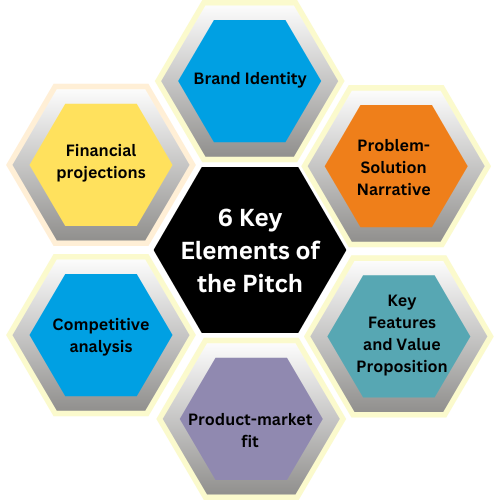
Figure 11.1
Here are six key elements of an entrepreneurial pitch from Media Innovation and Entrepreneurship.
- Brand identity image and tagline. Your presentation slide deck should begin with a memorable brand image. It can be a logo representing your product in a stylized way, or it could be a screen grab of your product wireframe (a computer rendering if it is a product, and a schematic or flow chart if it is a software/service business model.
- Problem-solution narrative. Some entrepreneurial ideas solve common problems. Some solve problems that users didn’t know they had. Communicate the problem-solution narrative succinctly. Incorporate visuals and a “hook” (skit, emotional testimonial, deep question, etc.) to connect directly with the audience. An effective technique when addressing a generally common problem is to ask the question while raising your hand to prompt the audience: “How many of you have experienced this issue/problem/challenge recently?”
- Key features and your value proposition. Your pitch can introduce potential investors, collaborators, employees, and others to your key features, your value proposition, and your user interface at the same time. Consider using a mockup of your product or images of a prototype to show your design capabilities while at the same time pointing out key features building to a value proposition. Or if you are a service or nonprofit venture, explain what you plan to provide to individuals or the community.
- Product-market fit description. Define the market niche clearly and explain how your innovation serves the market purpose precisely. Not every problem is one people would pay to fix. Explain why there’s a market to overcome this problem, how sizeable it is, and why your value proposition is the best.
- Competitive analysis. Demonstrate that your product is unique by defining its competition and illustrating how it will stand out in the marketplace. Investors will pay close attention to any missed or omitted competitors. They will want to see that you can establish barriers to entry, lest some immediate copycat eat up market share.
- Financial projections. The business model canvas (BMC) can help you understand and be able to visualize how your value proposition sits at the center of two dynamics: input and output cycles. Show what the overall market is worth: How big is this pie? Then, show how big your slice and your investor slice is going to be.
You don’t build pitch decks solely for the purpose of asking for money or support. That may be the primary objective, but when you work on your pitch, you build the narrative case again and again for why your idea has value and why other people should buy into your vision.
Elevator Pitches
An elevator pitch is an abbreviated pitch, a memorized talk that can get you in the door to put your full pitch deck on display. The elevator pitch should touch on the key elements of problem-solution, value proposition, product-market fit, and team, and not much else.
Giving an elevator pitch is an art. The elevator pitch can be memorized and should be. It might be delivered informally at networking events or at dinner parties or other social engagements. You never know when you might need to give an elevator speech. You might find yourself talking to someone who’d be interested in your venture, and it might be at a golf outing, on the ski slopes, on the street, in a store, or in a giant investment firm’s lobby. And of course, in elevators. That’s why it should be memorized and up to date.
Link to Learning: To develop the customer pitch for your product, review the article below.
Visit Monroe’s Motivated Sequence to learn more.
Watch the video below for ideas on how to capture your audience’s attention.
Project Focus
The audience for your project is potential customers. You will need to address the following elements in a 2 minute elevator pitch and include the link to your video in the Opportunity Model Portfolio.

Attribution
This work builds upon materials originally developed by OpenStax in their publication “Entrepreneurship,” which is licensed under CC BY 4.0.
a formal but brief presentation that is delivered (usually) to potential investors in a startup
an abbreviated pitch, a memorized talk that can get you in the door to put your full pitch deck on display